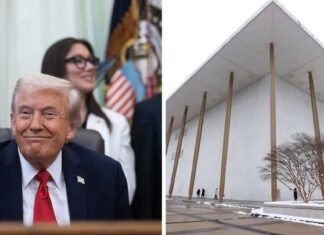
There are moments when the machinery of politics pauses, and what shines through instead is raw humanity. Thursday morning, at the solemn Pentagon ceremony marking the 24th anniversary of the September 11 attacks, President Donald Trump gave the nation such a moment. Standing with Melania at his side, stone-faced and visibly shaken, the president announced that Charlie Kirk — his friend, ally, and one of conservatism’s brightest young voices — would be awarded the Presidential Medal of Freedom posthumously.
“We miss him greatly,” Trump told the crowd. “Yet I have no doubt that Charlie’s voice and the courage he put into the hearts of countless people, especially young people, will live on.”
It was Trump’s first public event since Kirk’s assassination at Utah Valley University just a day earlier. The 31-year-old founder of Turning Point USA was shot by a sniper while engaging in one of his hallmark debates with students. The assassin remains at large, but the political and cultural impact of Kirk’s death is already echoing across the country.
Trump’s words carried both grief and resolve. “I can’t believe Charlie — what a great guy he was,” he told reporters after the ceremony. “You don’t replace a Charlie Kirk. He was unique.” He added that he would personally be speaking to Kirk’s widow, Erika, and their two small children later in the day.
It was Trump, fittingly, who first told the world that Kirk had died, posting on Truth Social that his “legendary” friend had perished. Hours later, in a somber video address from the Oval Office, he called Kirk a “martyr for truth and freedom” and praised his rare bond with America’s youth.
The Medal of Freedom, the highest civilian honor in the United States, now joins Kirk’s legacy. It cements his place not just in the conservative movement, but in the American story itself. “The date of the ceremony will be announced,” Trump told the Pentagon crowd, “and I can only guarantee one thing: we will have a very big crowd.”
But the president also drew a line of accountability. He placed blame squarely on the culture of demonization that has painted conservatives like Kirk as enemies rather than citizens. “For years, those on the radical left have compared wonderful Americans like Charlie to Nazis and the world’s worst mass murderers and criminals,” Trump said. “This kind of rhetoric is directly responsible for the terrorism we’re seeing in our country today, and it must stop right now.”
Melania Trump, in her own tribute, captured the cost of Kirk’s absence in a way that only a mother and wife could: “Charlie’s children will be raised with stories instead of memories, photographs instead of laughter, and silence where their father’s voice should have echoed.”
Meanwhile, Vice President J.D. Vance diverted his 9/11 plans to fly directly to Salt Lake City to be with Kirk’s family — an acknowledgment that this is not just a political loss, but a deeply personal one for the movement they both championed.
Charlie Kirk’s life was cut short, but his mission was not. By bestowing the Medal of Freedom, President Trump has ensured that Kirk’s courage, his voice, and his fight for liberty will not be forgotten. His assassin tried to silence him with a bullet. Instead, his voice has only grown louder, now amplified by the highest honor America can give.